


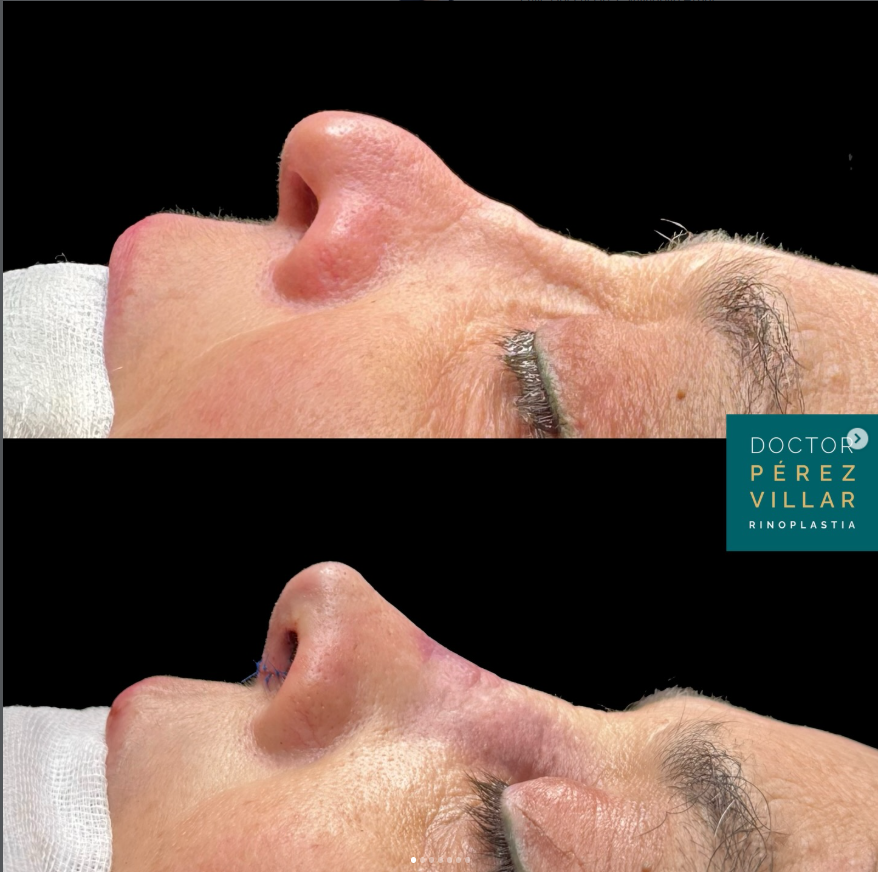
Nasal reconstruction in secondary rhinoplasty is probably one of the most challenging procedures in facial surgery. It is not just about improving appearance, but about rebuilding a damaged nose, restoring its function, and achieving a natural, long-lasting result.
Today, we present a real case treated by Dr. Pérez Villar, a specialist in ultrasonic rhinoplasty in Valladolid and maxillofacial surgeon. In this case, advanced techniques such as a rib cartilage graft were required to correct complex sequelae from a surgery performed more than 20 years ago.
Sequelae of a Previous Rhinoplasty
The patient came to consultation with a condition frequently seen in revision surgery: an outdated procedure that had left significant aesthetic and functional complications.
In this case, the nose presented:
- Dorsal collapse (saddle nose deformity)
- Pollybeak deformity
- Drooping nasal tip
- Septal deviation
- Septal perforation
- Nasal valve collapse
- Visible asymmetries
All of this affected not only the appearance of the nose but also a key aspect: breathing.
In these situations, this is not a standard cosmetic rhinoplasty, but a complete nasal reconstruction.
What is Secondary Rhinoplasty?
Secondary rhinoplasty is a procedure performed when a previous surgery has not achieved the desired result or has caused problems over time.
Unlike primary rhinoplasty, the surgeon must deal with:
- Previously operated tissues
- Lack of structural support
- Internal scarring
- Cartilage deficiency
For this reason, every case requires a highly personalized approach.
Nasal Reconstruction with Rib Cartilage Graft
In this case, the solution involved a nasal reconstruction using rib cartilage.
When the nasal structure is severely compromised, the patient’s own nasal or ear cartilage is often insufficient. Rib cartilage allows for a complete structural rebuild of the nose.
During the procedure, several techniques were combined:
- Reconstruction of the nasal dorsum
- Placement of spreader grafts
- Use of diced cartilage for smoother contouring
- Tip refinement and elevation
- Correction of asymmetries
The goal was not just aesthetic improvement, but to rebuild a functional nose from the ground up.
Functional Improvement
A key aspect of this case was functional correction.
In many cases, patients initially seek aesthetic improvement but suffer from significant breathing issues.
The procedure included:
- Septoplasty to correct septal deviation
- Repair of septal perforation
- Opening of collapsed nasal valves
This not only improves appearance but also restores proper nasal breathing, which has a direct impact on quality of life.
Why Use Rib Cartilage?
Rib cartilage is one of the most powerful tools in advanced secondary rhinoplasty.
It allows for:
- Strong and stable nasal structure
- Long-term durability
- Reduced risk of future collapse
Although technically demanding, it offers superior results in complex cases.
The Role of Ultrasonic Rhinoplasty in Nasal Reconstruction
Today, more advanced rhinoplasty techniques such as ultrasonic rhinoplasty are used in these procedures, allowing surgeons to work with much greater precision and control.
This makes the surgery less aggressive for the tissues, reduces swelling, and leads to a more comfortable recovery. It also allows for finer adjustments, resulting in more natural and predictable outcomes.
In practice, this means:
- Less tissue trauma
- Reduced inflammation
- Faster recovery
- More precise results
The Result: Natural, Balanced and Functional
The goal is not to create a “perfect” nose, but one that is:
- Natural
- Harmonious with the face
- Functional
- Stable over time
In this case, both facial harmony and breathing function were successfully restored.
Choosing a Specialist in Nasal Reconstruction
Secondary rhinoplasty requires specific expertise. Not all surgeons perform these procedures or have the necessary experience.
Choosing a specialist in advanced nasal reconstruction and rhinoplasty is key to achieving safe and long-lasting results.
Comments are closed.