


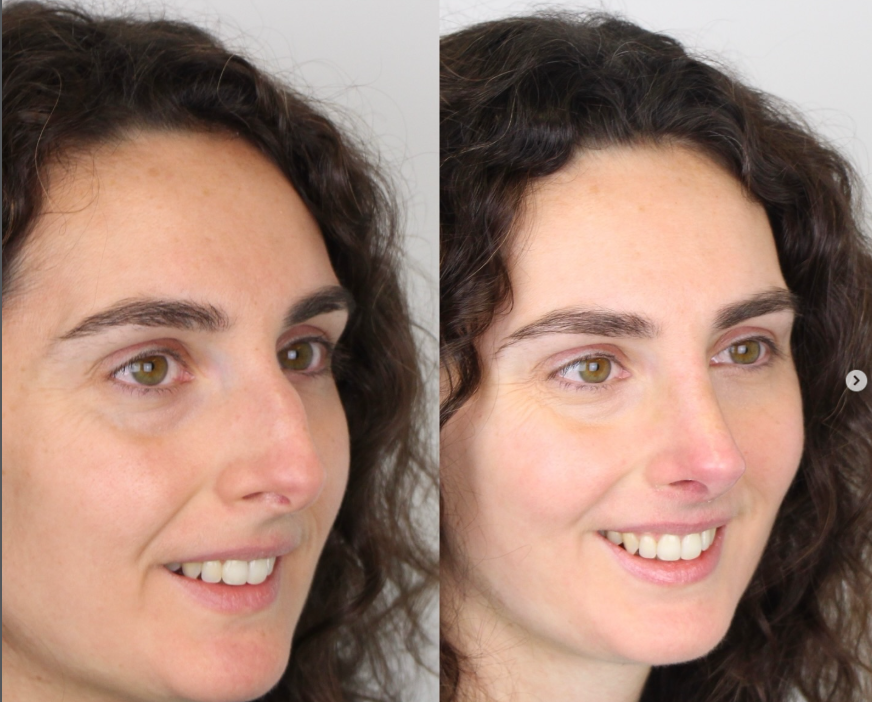
When someone considers rhinoplasty, they usually think about a perfect side profile or a more harmonious front view. However, in real life, people rarely see us from those static angles. Most interactions happen in motion, during conversations, in everyday gestures. That’s where the three-quarter profile comes into play — a much more realistic perspective of how others actually see us.
For this reason, modern ultrasonic rhinoplasty is not only evaluated through classic before-and-after images, but also by how the nose integrates with the face from this intermediate angle. Understanding this concept is essential to having realistic expectations and truly understanding what a natural result means.
Ultrasonic rhinoplasty is a surgical technique that uses ultrasound energy to reshape the nasal bones with greater precision and control. This approach allows for finer structural adjustments, which is especially relevant when aiming for harmony in complex angles like the three-quarter profile, where small details can significantly influence overall facial perception.
What is the three-quarter profile and why does it matter
The three-quarter profile is the angle between the frontal view and the full side profile. In practice, it is how people see us when we are speaking, slightly turning our head, or interacting naturally.
From this perspective, several aspects are evaluated that may not be as visible in other views. These include tip projection, meaning how far the tip extends from the face, and tip definition, which affects whether the nose appears refined or rounded. The continuity of the nasal dorsum is also key, as any irregularity can become more noticeable from this angle.
In addition, aesthetic lines from the bridge to the tip, nasal rotation, and the transition between the nose and upper lip are assessed. Together, these elements create a global perception that goes beyond the nose as an isolated feature.
The angle that reveals naturalness
One reason the three-quarter profile has become so important is that it clearly reveals whether a result looks natural or not.
A nose may appear correct in a side profile photo, but from the three-quarter angle it may show stiffness, excessive definition, or disproportionate projection. It is also the angle where subtle asymmetries or overcorrections can be detected.
When the result is well achieved, it does not look like a “surgical nose,” but rather conveys facial harmony. The nose does not stand out on its own — it blends naturally with the rest of the face.
What defines a good three-quarter result
A successful result is not about achieving perfection, but balance.
The dorsum should appear smooth and continuous, without irregularities. The tip should be defined but not overly sharp. Projection must be proportionate to the face, avoiding an overly prominent or under-projected appearance.
Rotation also plays a role in facial expression. Excessive rotation may look unnatural, while insufficient rotation may create a drooping effect. The transition between the nose, lips, and cheeks should feel seamless.
All of this contributes to a natural appearance, especially in everyday situations.
Ultrasonic rhinoplasty and precision
Ultrasonic technology allows surgeons to reshape nasal bones in a more controlled way, enabling refined adjustments in specific areas. This is particularly useful when aiming to improve harmony in the three-quarter profile.
By minimizing impact on soft tissues, it allows for more delicate structural work. This does not guarantee results, but it provides tools that may help refine details that influence overall perception.
In rhinoplasty, the goal is often not dramatic change, but subtle adjustments that improve facial balance.
When this angle becomes especially important
The three-quarter profile is particularly relevant for patients who feel their nose does not fully “fit” their face, even if they cannot clearly identify why.
It is especially important in cases with poorly defined or drooping tips, minor dorsal irregularities, or in revision rhinoplasty where the goal is to improve naturalness.
It is also highly relevant for patients concerned about how they appear in photos and videos, where this angle is very common.
Surgical planning with the three-quarter profile in mind
Planning is not based solely on frontal or lateral views. The entire face is analyzed from multiple angles, including the three-quarter view.
Skin quality, bone structure, tip shape, and facial proportions are evaluated. Based on this, a personalized surgical plan is developed.
There are no standard results. Each nose requires an individualized approach.
Postoperative evolution
After surgery, swelling — especially in the nasal tip — can affect how the three-quarter profile looks.
Results are not immediate. Changes occur gradually as swelling subsides and definition improves.
Patience and proper follow-up are essential during this process.
Risks and limitations
Rhinoplasty, even with advanced techniques, has limitations.
Results may not fully match expectations, minor asymmetries may remain, and in some cases additional adjustments may be needed. Swelling may persist longer in certain areas.
Understanding these factors is part of making an informed decision.
Real case: where the difference is truly seen
In many real cases, the most noticeable improvement is not in the classic side profile, but in how the nose integrates into the face from the three-quarter angle.
This is where naturalness becomes evident — the nose no longer stands out, but becomes part of a harmonious whole.
Many thanks to our patient for allowing us to share her case. These examples help illustrate that rhinoplasty is not about changing a nose, but about improving how it fits within the face.
Safety and trust
Rhinoplasty is a medical procedure that requires careful evaluation.
An experienced surgeon plays a key role in planning, performing, and monitoring the procedure. Understanding expectations, limitations, and following postoperative care is essential.
Conclusion
Talking about ultrasonic rhinoplasty and the three-quarter profile means understanding results in a more realistic way. Beyond perfect photos, what truly matters is how the nose looks in everyday life.
The goal is not perfection, but harmony — a nose that fits naturally from every angle, especially the one that matters most: how others see you.
Comments are closed.